
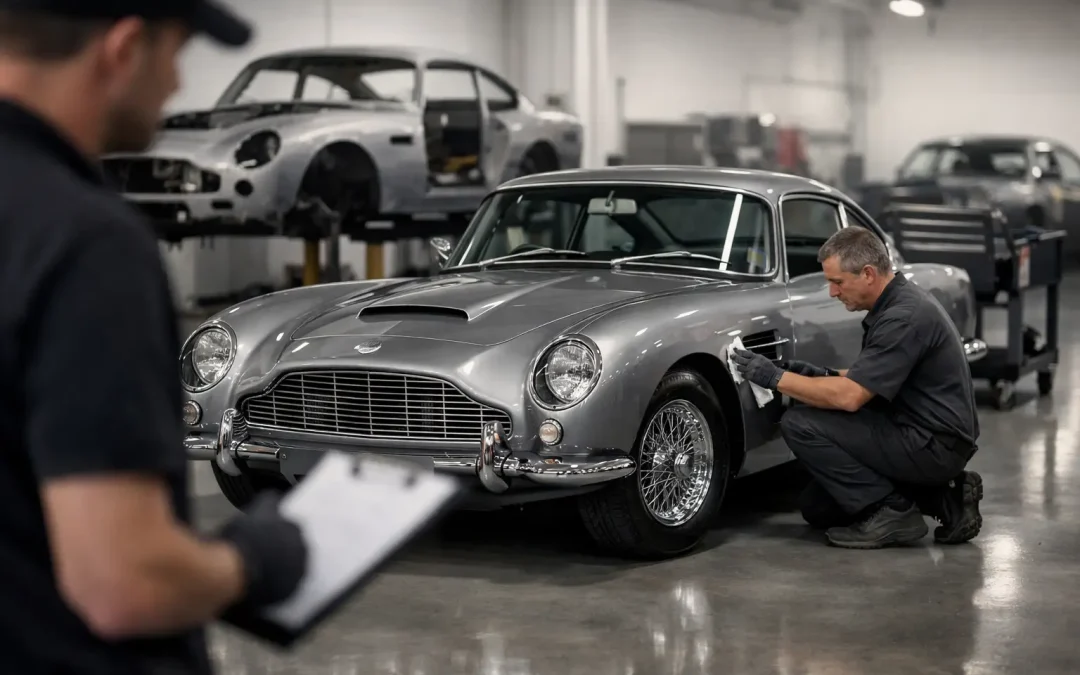
An Aston Martin can look complete from twenty feet away while hiding corrosion, poor prior repairs, incorrect trim, or mechanical work that has simply been deferred. That is why choosing an Aston Martin restoration specialist is not a matter of finding the nearest workshop with a paint booth. It is about placing a significant car with people who understand what should be preserved, what must be renewed, and what will affect its value when the work is finished.
For owners and collectors, the right restoration begins with judgment. A DB model, V8, Virage, or later Gaydon-era Aston Martin deserves more than a cosmetic refresh. Each has its own construction, common weaknesses, parts considerations, and character. The aim should be a car that remains authentic, usable, and properly documented – not one that merely presents well for sale.
What an Aston Martin Restoration Specialist Should Assess First
A proper assessment comes before a quotation. A reputable specialist will take the time to inspect the body, chassis or structure, mechanical systems, interior, electrical equipment, and available history. On a classic or modern classic Aston Martin, the visible condition is only one part of the picture.
Corrosion can be concealed beneath old underseal, filler, or attractive paint. Panel alignment may reveal accident damage or previous metalwork. A car that starts readily may still need attention to its cooling system, fueling, brakes, suspension bushes, gearbox, or differential. With later cars, diagnostics and electrical faults require a different level of knowledge, particularly where low use, battery condition, and age-related module issues are involved.
The inspection should also establish the owner’s objective. Some cars need sympathetic preservation, retaining as much original material as possible. Others need a full rebuild after long-term storage, accident damage, or neglected maintenance. A third category may be prepared for regular touring, where discreet improvements to reliability, cooling, braking, or ignition make good sense. These are different jobs and should not be priced or planned as though they are the same.
Restoration Should Protect Character and Value
The most expensive route is often an unclear one. Stripping a car without a defined scope can expose further work, create delays, and leave an owner making major decisions under pressure. A specialist should explain the likely stages, identify areas of uncertainty, and keep the work tied to an agreed purpose.
Originality matters, but it is not an absolute rule. An original interior with a pleasing patina may be more desirable than a newly trimmed cabin in the wrong material or shade. Period-correct components are generally preferable to convenient substitutes, particularly on collector-grade cars. At the same time, safety and dependable road use matter. The best decisions balance factory specification, the condition of the individual car, and how the owner intends to use it.
Paintwork is a good example. A full repaint may be justified where corrosion repairs or old finishes demand it. If the existing paint is sound and largely original, careful correction and localized repair may preserve more of the car’s history. The same principle applies to chrome, wood, leather, instruments, wheels, and engine components. Replacement should be considered carefully, not treated as the automatic answer.
The Value of Marque-Specific Experience
Aston Martin restoration work requires broad skills, but it also benefits from focused marque knowledge. An experienced workshop recognizes details that a general repairer may overlook: the correct fit and finish of trim, the construction methods used on particular eras, the availability of parts, and the faults that need attention before they become serious.
That knowledge also helps with realistic budgeting. Some parts can be rebuilt, repaired, or sourced through established specialist networks. Others may require careful fabrication or a longer search for correct replacements. A good specialist will not promise an immediate answer where one is not possible. Instead, they will explain the options and advise where spending money will make the greatest difference to the car.
For cars with incomplete history, the workshop’s assessment becomes even more valuable. Signs of prior repairs, incorrect components, and non-standard modifications can be identified early. This gives an owner a clearer picture of what they own and prevents a restoration from unintentionally reducing the car’s appeal.
Documentation Is Part of the Work
A restoration should leave a paper trail as well as an improved vehicle. Before-and-after photographs, invoices, parts records, and notes on significant decisions provide useful evidence for future servicing, insurance, and eventual sale. They also show that the car was restored responsibly rather than simply made presentable.
This is particularly relevant when a car has been stripped for body repairs or mechanical rebuilding. Photographs of the underlying structure, repair stages, and component condition help demonstrate the quality of work that cannot be seen once the car is reassembled.
Questions Worth Asking Before You Commit
The first conversation with a restoration business should be practical. Ask whether the work is carried out in-house or subcontracted, how estimates are managed when hidden defects are found, and how frequently progress will be reported. You should also ask whether the workshop has experience with your specific Aston Martin model and whether it can support the car after the restoration is complete.
It is sensible to discuss parts policy as well. Will original parts be retained where possible? Are reproduction or upgraded components being proposed, and why? If a non-original solution is the best option for reliability or safety, the reasoning should be clear. There is nothing wrong with a well-considered upgrade, but it should be a deliberate choice rather than an undocumented alteration.
Four signs of a well-managed restoration are especially reassuring:
- A detailed initial inspection rather than a quick estimate based on photographs alone.
- A written scope that separates essential repairs from optional improvements.
- Clear approval points if further issues are uncovered during disassembly.
- Regular photographic updates and complete invoices when the car is returned.
These basics protect both parties. They help the owner control the budget and allow the workshop to carry out the job properly instead of cutting corners to meet an unrealistic figure.
Full Restoration, Repair, or Sympathetic Recommissioning?
Not every Aston Martin requires a full restoration. A car that has been stored for years may first need recommissioning: careful inspection, fluid changes, fuel-system attention, brakes, tires, belts, hoses, and a measured return to the road. This can be the sensible route for an original, low-mileage car where dismantling everything would add cost without adding corresponding value.
A partial restoration may suit a car with sound mechanicals but tired paint, worn leather, or localized corrosion. Full restoration is normally justified when structural condition, accident damage, major mechanical failure, or a poor earlier rebuild means that piecemeal work will not provide a lasting result.
The right answer depends on condition, provenance, intended use, and budget. A concours-minded collector may prioritize period correctness at every stage. An owner planning long continental trips may reasonably favor reliability improvements that are reversible and sensitively installed. A specialist should be comfortable advising both approaches.
A Trusted Partner From Collection to Completion
For owners in North London, Hertfordshire, and surrounding areas, a specialist that can arrange collection removes one of the practical worries of a non-running or partially dismantled car. More importantly, it allows the restoration to be managed by one accountable team from the first inspection through to final road testing.
Tedella Ltd brings more than 25 years of hands-on experience in prestige British vehicles, including Aston Martin restoration, repair, sourcing, and sympathetic refurbishment. The focus is straightforward: understand the car, agree the right scope of work, and return it in a condition that supports both ownership enjoyment and long-term value.
Before committing to a major project, arrange a proper appraisal and bring the car’s history, photographs, and concerns to the discussion. The best restoration plan begins with an honest assessment – and ends with an Aston Martin you will be proud to drive, show, and keep.
Recent Comments