
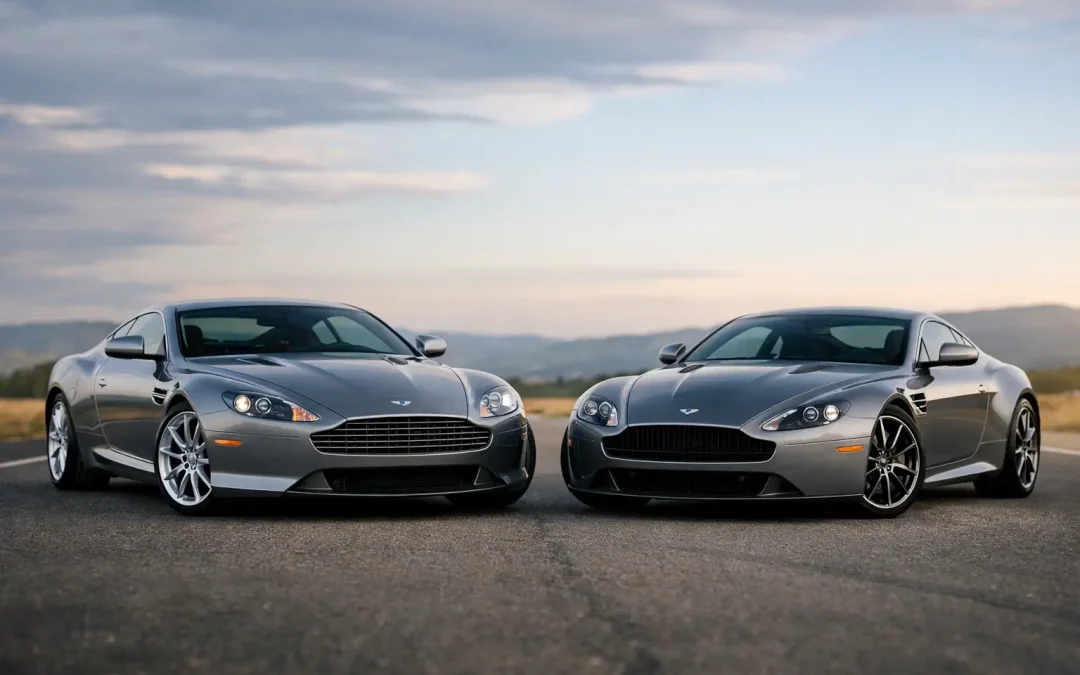
The Aston Martin DB9 vs V8 Vantage decision is not simply a question of twelve cylinders against eight. These are two distinctly different interpretations of the Aston Martin experience. One is a long-legged grand tourer built for covering serious distance with ease; the other is a compact, more immediate sports car that makes even a short drive feel like an occasion.
Both offer the hand-finished cabin, elegant proportions, and unmistakable sense of occasion that draw buyers to the marque. The better choice depends on how you intend to use the car, the transmission you prefer, and whether you value effortless pace or a more involved drive.
Aston Martin DB9 vs V8 Vantage: The Core Difference
The DB9 is the traditional Aston Martin grand tourer. Its 5.9-liter V12 delivers broad, unhurried power, and the car feels composed at highway speeds or on a long continental trip. It has a more generous cabin, a usable rear seat for occasional passengers, and a ride that favors refinement over outright sharpness. A DB9 coupe feels special from the first turn of the key, while the Volante adds open-air touring without losing the car’s essential character.
The V8 Vantage is the more compact and athletic proposition. It has a shorter wheelbase, a lower, tighter driving position, and a sense of agility that the larger DB9 cannot quite match. Early examples use a 4.3-liter V8, while later cars gained the stronger 4.7-liter engine. Both have an engaging character, although the 4.7-liter version brings worthwhile additional torque and a more flexible response.
Put simply, the DB9 is the car for the journey. The V8 Vantage is the car for the road itself.
Driving Character and Performance
A DB9 does not need to be driven hard to feel rewarding. The V12 provides smooth, muscular acceleration with a deep, cultured exhaust note, and the car settles into its stride with remarkable confidence. The steering is measured rather than hyperactive, the ride is generally more forgiving, and the overall experience feels mature. For an owner who wants an Aston Martin to use regularly for weekends away, business trips, or long scenic drives, this is a major advantage.
The V8 Vantage feels more alert at normal road speeds. It is narrower, easier to place, and more playful through a sequence of corners. The naturally aspirated V8 encourages the driver to use the rev range, particularly in the 4.3-liter cars. A well-sorted manual Vantage has a directness that appeals strongly to enthusiasts, while the later 4.7-liter version provides a more relaxed turn of speed without losing the model’s compact feel.
Transmission choice matters greatly. The DB9’s conventional automatic suits its grand-touring role extremely well, especially in traffic or on longer trips. Early manual DB9s are rare and appealing, but buyers should choose one because they genuinely want the additional involvement, not simply because of its scarcity.
The V8 Vantage was available with a conventional manual or Aston Martin’s Sportshift automated manual. Sportshift can be enjoyable when driven decisively, but it is not a conventional automatic and should not be expected to behave like one in slow traffic. A careful road test is essential. Check that gear changes are clean, that the clutch engages properly, and that there is no hesitation, warning message, or excessive driveline shunt.
Cabin, Practicality, and Everyday Use
The DB9 has the advantage if you regularly travel with another couple, carry soft luggage, or simply appreciate more space around you. Its 2+2 layout is best viewed as occasional seating rather than a family arrangement, but it remains more versatile than the Vantage. The cabin has a more formal, luxurious atmosphere, with sweeping lines and a sense of occasion suited to the car’s flagship position.
The V8 Vantage cabin is more intimate. This is a two-seat sports car first and foremost, and taller drivers should spend time behind the wheel before committing. Its smaller dimensions are useful on narrow roads and in parking spaces, but there is less room for luggage and far less accommodation for passengers.
Neither car should be bought purely as practical transportation. Both are prestige British cars that reward attentive ownership. Yet a properly maintained example can be used far more often than many buyers expect. The key is to buy condition, history, and specification rather than being distracted by the lowest advertised price.
What Ownership Really Requires
The aluminum-intensive architecture used by both models was advanced for its era and has aged well when cared for correctly. That does not mean a pre-purchase inspection can be skipped. These cars are sophisticated machines with premium parts costs, and deferred maintenance can quickly erase an apparent saving.
A complete service file is fundamental. Look for evidence of regular servicing, invoices that show what has actually been done, and confirmation that the car has been used enough to stay healthy. A very low-mileage car is not automatically the best car. Long periods sitting unused can affect batteries, tires, seals, brakes, fluids, and electrical systems.
On a DB9, attention should be paid to cooling-system condition, suspension wear, braking components, electrical functions, and the operation of the automatic transmission. The V12 is a strong, charismatic engine, but routine work involves more parts and more labor than on the V8. A car with fresh tires, sound suspension, a healthy battery system, and documented maintenance is usually the wiser purchase than a cheaper example awaiting several years of catch-up work.
On a V8 Vantage, inspect the clutch and transmission operation closely, particularly on Sportshift cars. Engine service history, cooling-system health, suspension components, brake condition, and the operation of all cabin electrics should also be reviewed. Early 4.3-liter cars can represent excellent value, but a later 4.7-liter car may justify its higher price for buyers who want stronger performance and broader appeal.
With either model, examine the bodywork carefully in good light. Panel fit, paint consistency, wheel condition, underbody care, and the condition of the interior leather and trim all reveal how a car has been treated. Cosmetic refurbishment is possible, but originality and careful preservation remain valuable.
Which Aston Martin Fits Your Priorities?
Choose the DB9 if you want a refined V12 Aston Martin with genuine long-distance ability. It suits the buyer who values presence, comfort, and the particular theater of a naturally aspirated twelve-cylinder engine. It is also the better choice if a Volante is part of the plan, or if you want a car that can comfortably handle a weekend away with luggage.
Choose the V8 Vantage if you want the more focused driver’s car. It is the stronger fit for weekend runs, country roads, and owners who enjoy a manual gearbox and a compact sports-car feel. The Vantage can also be easier to enjoy in tighter urban environments, although its low seating position and wide doors still require care in parking situations.
For collectors, specification can alter the equation. A manual V8 Vantage, a desirable factory color combination, low owner count, and exemplary documentation can be more compelling than a newer but poorly presented example. Likewise, a late DB9 with a strong history and careful stewardship may be a better long-term proposition than an earlier car with neglected needs.
Buy the Example, Not Just the Model
There is no wrong answer between these two Aston Martins, provided the car has been inspected properly and its ownership needs are understood. The most satisfying purchase is usually the example with clear provenance, consistent maintenance, correct operation, and a specification you will continue to enjoy after the novelty has passed.
At Tedella Ltd, more than 25 years of hands-on experience informs our approach to sourcing, assessing, repairing, and restoring prestige British cars. Before making a decision, arrange a specialist inspection, review the history in detail, and drive both models if possible. The right Aston Martin should feel less like a compromise and more like the car you will look forward to maintaining, preserving, and driving for years.
Recent Comments