
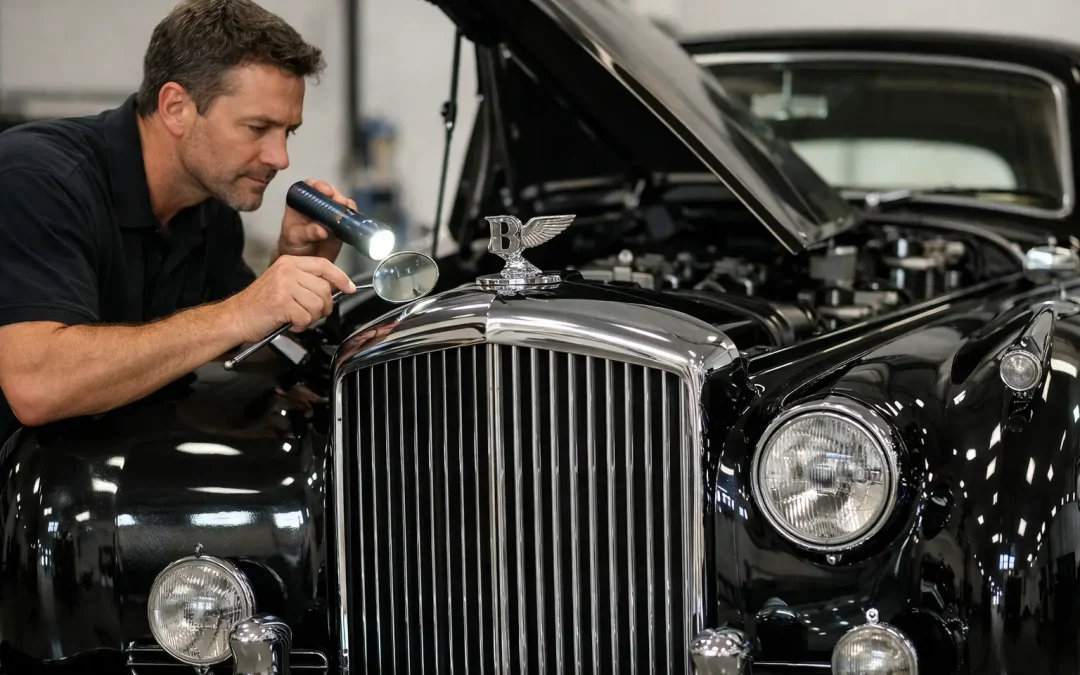
A Bentley can look magnificent under showroom lights and still carry expensive deferred work beneath the surface. Knowing how to inspect a classic Bentley properly means looking beyond polished paint, quilted leather, and a smooth idle. For Bentley Continental GT and GTC buyers in particular, condition, service history, and specialist maintenance matter far more than a tempting purchase price.
A careful inspection will not replace a full pre-purchase examination by a marque specialist, but it will help you identify the right questions, recognize warning signs, and avoid committing to a car that needs more attention than its value supports.
Start With Provenance, Not the Paintwork
Before inspecting the car itself, inspect its history. A well-kept Bentley should have a substantial folder of invoices, service stamps, inspection records, and evidence of work carried out by reputable Bentley or prestige-car specialists. Mileage is relevant, but it is not the whole story. A regularly used, correctly maintained Continental can be a stronger purchase than a low-mileage example that has stood unused for long periods.
Check that the VIN matches the vehicle paperwork and that the vehicle specification is consistent with the car in front of you. Original build details, factory options, keys, manuals, and service books all support provenance. On a desirable GTC, correct specification can also influence future appeal. A car with an attractive factory color combination, desirable wheels, and a documented ownership history is generally easier to enjoy and sell on.
Pay close attention to gaps in servicing. A missing invoice is not automatically a concern, particularly on older cars, but several years without credible maintenance evidence deserves investigation. Ask when the transmission, brakes, suspension components, batteries, tires, and convertible roof system were last attended to. These are not minor consumables on a Bentley.
How to Inspect a Classic Bentley Body and Cabin
Walk around the car slowly in daylight. Look along each side rather than directly at the paint, as this helps reveal ripples, poor panel preparation, and mismatched paintwork. Panel gaps should be consistent, especially around the hood, doors, trunk lid, and front fenders. A repaint is not necessarily a reason to walk away, but it should be explained honestly and reflected in the price if the work is not to a high standard.
Check lower body areas, wheel arches, door bottoms, sills, and the underside for corrosion, poor previous repairs, or damage from incorrect lifting. Continental models are sophisticated, heavy grand tourers, and neglected suspension or underbody work can become costly quickly. Inspect the alloy wheels closely for curb damage, cracks, corrosion around the center caps, and signs of repeated refinishing.
The cabin should feel special, but do not allow the leather and wood veneer to distract from practical checks. Test the seat adjustment in every direction, including memory functions, lumbar support, heating, cooling where fitted, and electric steering-column movement. Examine the seat bolsters for excessive wear relative to the stated mileage. Shrinkage, lifted veneer, sagging headliner fabric, and sticky interior switches may be repairable, but they indicate the standard of care the car has received.
A light scent of leather is normal. A damp or musty smell is not. Lift the floor mats, inspect the footwells, and look carefully in the trunk. Water ingress can affect electrical systems and may point to blocked drains, tired seals, or roof-related issues.
Inspect the Convertible Roof With Patience
On a Continental GTC, roof operation deserves a dedicated check. Run the roof through a full opening and closing cycle, ideally more than once. The process should be steady and controlled, without warning messages, hesitation, unusual hydraulic noises, or the need to assist a panel by hand.
Inspect the fabric hood for scuffs, worn folds, staining, loose stitching, and damage around its edges. Check that the roof sits neatly against the windshield frame and side glass when closed. The windows should drop and rise correctly as the roof operates, and the trunk partition must be in its correct position for the mechanism to function safely.
Do not accept the explanation that a roof fault is simply a sensor. Sometimes it is. Sometimes it is the beginning of a more involved diagnostic and repair process. A proper specialist inspection will establish whether the issue is adjustment, electrical, hydraulic, or structural.
Check Electronics Before the Road Test
Bentleys from this era are highly equipped cars, and their electrical systems need a healthy battery and correct charging voltage to operate as intended. A car that has been standing may display intermittent faults that disappear after a drive, but recurring warnings should never be dismissed without diagnosis.
Switch on every electrical item you can reasonably test. This includes the infotainment screen, navigation, audio system, climate control, parking sensors, cameras where fitted, windows, mirrors, central locking, exterior lights, interior lights, wipers, heated rear window, and all dashboard functions. Confirm that no warning lights remain illuminated after start-up.
Check the air conditioning carefully. It should produce cold air promptly, and the climate controls should respond correctly on both sides of the cabin. Repairing a poorly functioning climate system can involve more than a simple recharge. Likewise, a non-working infotainment system may be an inconvenience, or it may be part of a wider electrical problem.
Bring a diagnostic scan into the process before money changes hands. A specialist-level scan can identify stored faults, communication issues between control modules, and warning codes that are not visible on the dashboard. It is one of the most valuable steps in a Bentley pre-purchase inspection.
Examine the Engine, Transmission, and Suspension
Ask to see the car from cold. An engine that has been warmed before you arrive may conceal an awkward start, smoke, poor idle, or warning light. Listen for unusual rattles, tapping, misfires, or excessive mechanical noise. The W12 engine is a remarkable unit, but it demands correct maintenance. The later V8 models are also excellent cars, with their own servicing requirements and no immunity from neglect.
Look for oil leaks, coolant staining, damaged hoses, and signs of improvised repairs in the engine bay. Fluid levels should be correct, though a clean engine bay alone proves very little. Service records are more meaningful than freshly applied dressing.
During the road test, the transmission should shift cleanly and predictably. Early Continental models and later eight-speed cars feel different, but neither should flare excessively, slam into gear, or hesitate when selecting drive or reverse. Make sure the test includes gentle driving, firm acceleration, low-speed maneuvering, and a period at normal road speed.
The air suspension should raise and lower the car smoothly, with no warning messages or uneven ride height. Over broken surfaces, listen for knocks, creaks, or clunks from suspension components. A Bentley should feel composed rather than loose. Check the brakes for vibration, pulling, a soft pedal, or corrosion on discs caused by long storage.
Tires deserve more attention than many buyers give them. Confirm that all four are from reputable brands, correctly sized, and evenly worn. Look at the date codes as well as the tread depth. A car can have deep tread on tires that are old, hardened, or unsuitable for the vehicle.
Judge the Car as a Complete Ownership Proposition
The best Bentley is not always the lowest-mileage car or the cheapest example advertised. It is the car with believable history, sound mechanical condition, correct operation, and an owner or dealer prepared to answer direct questions. Budget for ongoing care from the outset. Even a good car benefits from preventive maintenance, and specialist ownership is part of preserving both the driving experience and long-term value.
If a seller discourages an independent inspection, cannot explain warning lights, or offers vague answers about servicing, treat that as useful information. There will always be another car. Conversely, a well-presented Continental GTC with strong records, a correctly operating roof, and evidence of recent specialist work can represent excellent value in prestige motoring.
For buyers in North London, Hertfordshire, and surrounding areas, Tedella Ltd can assist with a practical assessment of a prospective Bentley, as well as repairs, refurbishment, and ongoing ownership support. The right inspection is not about finding perfection in an older prestige car. It is about understanding its condition clearly enough to buy with confidence and enjoy it as intended.
Recent Comments